
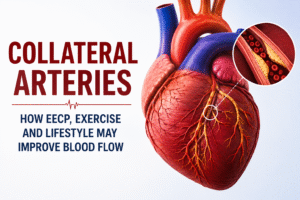
When it comes to heart blockages, it’s all about blood flow. There is a realistic hope: our heart has extra blood vessels called collateral arteries, which can help improve blood flow when the main arteries are narrowed or blocked. Better blood flow can mean less chest pain and improved energy, because the heart receives more oxygen when blood circulation improves. Let’s understand it.
Way to improve blood flow
The heart needs a continuous supply of oxygen-rich blood to keep beating. This blood is delivered through the coronary arteries, which run over the surface of the heart and supply different areas of the heart muscle.
But what happens when one of these arteries becomes severely narrowed or blocked?
The body has a fascinating backup system called coronary collateral circulation.
Collateral arteries are small blood-vessel connections that link different coronary arteries or their branches. When blood flow through a major coronary artery becomes restricted, these vessels can provide an alternative route for blood to reach areas of the heart muscle.
However, collateral arteries should not be thought of as a guaranteed replacement for a normal coronary artery. Their size, number and ability to carry blood vary considerably from person to person.
So, can collateral arteries develop around a blocked artery? Can exercise help? And can they protect the heart from a heart attack?
Let’s understand the science behind collateral circulation.
What Are Collateral Arteries?
Collateral arteries are alternative blood-vessel pathways that connect different parts of the coronary circulation.
Some of these connections already exist in a small form, even in people who do not have significant coronary artery disease. When a coronary artery becomes severely narrowed or blocked, differences in pressure and blood flow can stimulate enlargement and remodeling of these existing vessels. This process is often called arteriogenesis.
A simple way to understand it is to imagine a road network.
Suppose the main road between two cities becomes blocked. If smaller connecting roads already exist, traffic may be able to use those alternative routes.
Collateral arteries work somewhat like these alternative roads for blood flow.
They don’t necessarily replace the original artery completely, but they may provide additional blood supply to an area that is receiving less blood through its usual route.
Does Everyone Have Collateral Arteries?
Interestingly, collateral vessels can exist even in people without diagnosed coronary artery disease.
Research suggests that humans have naturally occurring coronary connections, but the extent and functional importance of collateral circulation varies greatly between individuals.
Some people develop a relatively well-developed collateral network, while others have much less collateral blood flow.
Several factors appear to influence collateral development, including:
-
- Severity of coronary artery narrowing
-
- Duration of coronary obstruction
-
- Individual biological and genetic factors
-
- Pressure and blood-flow changes
-
- Overall cardiovascular health
This is one reason why two people with similar-looking coronary artery disease on an angiogram may not experience exactly the same symptoms.
How Do Collateral Arteries Develop?
The development of larger functional collateral vessels is a complex biological process.
When blood flow through a major coronary artery is significantly reduced, the pressure difference between the blood vessels connected by collateral channels can increase.
This creates shear stress on the inner lining of the blood vessels.
That mechanical signal can trigger biological processes that cause existing small collateral channels to enlarge and remodel. This process is known as arteriogenesis.
It is important to understand that this is not simply the body creating a completely new large artery from nothing.
In many cases, the process involves the enlargement and remodeling of pre-existing small vascular connections. In Today’s world EECP machine is used as a tool to activate the collateral arteries.
Can EECP Therapy Help Improve Collateral Circulation?
EECP (Enhanced External Counterpulsation) is a non-invasive therapy that uses inflatable cuffs placed around the legs, thighs and buttocks.
The cuffs inflate and deflate in synchronization with the heartbeat. This can increase blood flow toward the heart during certain phases of the cardiac cycle and may reduce the workload on the heart.
Because EECP repeatedly changes blood flow and pressure in the blood vessels, researchers have investigated whether it may also support the development or function of coronary collateral circulation.
Some studies suggest that EECP may improve blood flow and may have beneficial effects on the body’s natural collateral circulation. However, EECP should not be considered a guaranteed way to create new coronary arteries or to remove an existing blockage.
EECP is generally considered for selected patients with coronary artery disease, particularly those with persistent symptoms despite appropriate conventional treatment, depending on their individual medical condition.
It is also important to understand that EECP does not physically open a blocked coronary artery like angioplasty or remove a blockage like a stent procedure. Its potential benefit is related to improving blood-flow patterns and supporting the heart’s circulation.
Therefore, EECP, when appropriate, should be considered as part of a broader treatment plan that may include prescribed medication, appropriate physical activity, a heart-healthy diet and lifestyle changes, all under the guidance and supervision of a qualified healthcare professional.
If you have coronary artery disease or a significant coronary blockage, you should not start EECP on your own. A cardiologist should determine whether this therapy is appropriate for you.


Can Collateral Arteries Develop Around a Blocked Coronary Artery?
Yes, they can.
When coronary artery disease progresses gradually, collateral circulation may develop or become more functionally important over time.
Research has found that the presence and development of coronary collaterals are associated with the severity and duration of coronary obstruction.
This is particularly relevant in people with chronic coronary artery disease or chronic total coronary occlusion.
However, collateral development is not predictable enough to assume that every blocked artery will automatically receive adequate alternative blood flow.
That’s an important distinction.
A blocked artery does not automatically mean:
“My body will create another artery and I won’t need treatment.”
That assumption can be dangerous.
Collateral circulation can be helpful, but its effectiveness differs from person to person.
Can Collateral Arteries Prevent a Heart Attack?
Collateral circulation may provide some protection when blood flow through a coronary artery is severely reduced.
Research has associated well-developed coronary collateral circulation with reduced ischemic injury and, in some studies, better outcomes following coronary events.
But collateral arteries cannot guarantee protection from a heart attack.
A sudden blockage can occur faster than collateral circulation can compensate. Furthermore, collateral vessels may provide enough blood flow for the heart at rest but may not provide enough during situations when the heart needs much more oxygen, such as strenuous exercise.
Therefore, having collateral circulation should not be considered a substitute for appropriate medical treatment.
Can Exercise Improve Collateral Circulation?
This is one of the most interesting areas of cardiovascular research.
Exercise increases blood flow through the cardiovascular system and produces changes in the forces acting on blood-vessel walls. These changes may contribute to mechanisms involved in collateral vessel development.
A 2026 scoping review identified multiple studies investigating exercise and other interventions for improving coronary collateral circulation, with several studies reporting improvements in measures of collateralization. However, the authors also emphasized the need for more robust clinical trials.
So the scientifically responsible conclusion is:
Exercise may support collateral circulation in some people, but exercise should not be considered a guaranteed way to create new blood vessels around a blocked coronary artery.
And if someone has known coronary artery disease, exercise intensity should be discussed with their healthcare professional, particularly before starting vigorous exercise. Doctors will guide you to control the pace of improvement.
Can Walking Help Your Heart?
Walking is one of the most accessible forms of physical activity and can contribute to overall cardiovascular fitness.
Regular physical activity can support several important aspects of cardiovascular health, including:
-
- Better physical fitness
-
- Improved exercise capacity
-
- Better management of cardiovascular risk factors
-
- Weight management
-
- Improved overall cardiovascular health
Research specifically investigating exercise and coronary collateral development is promising but does not mean that a particular walking routine will definitely create collateral arteries in an individual.
Walking is a magical activity. I will explain it soon in future articles.
How Do Doctors Detect Collateral Arteries?
Collateral circulation can sometimes be seen during coronary angiography.
Doctors may observe contrast flowing through collateral channels from one coronary artery toward another area supplied by a diseased or occluded artery. The extent of visible collateral filling can be graded using systems such as the Rentrop classification.
For research and specialized assessment, doctors can also measure collateral blood flow using invasive techniques involving pressure or Doppler measurements.
These techniques can provide more information about how effectively the collateral circulation is functioning.
Are Collateral Arteries the Same as a Bypass?
No.
Collateral arteries and coronary artery bypass grafts are very different.
Collateral arteries
They are naturally occurring vascular connections that can enlarge and become functionally important.
Coronary bypass surgery
A surgeon creates a new route for blood to flow around a diseased coronary artery using a graft.
So, although both can provide an alternative route for blood flow, they are not the same thing.
What Factors Can Affect Collateral Development?
Collateral circulation is influenced by several biological and cardiovascular factors.Some important factors studied include:
1. Severity of coronary narrowing
More significant obstruction can create stronger pressure and flow changes that may stimulate collateral remodeling.
2. Duration of coronary disease
Long-standing coronary obstruction can be associated with more developed collateral vessels.
3. Individual biology
People respond differently. Genetic and other biological factors may partly explain why collateral development varies between individuals.
4. Physical activity
Exercise has been investigated as a possible stimulus for collateral development, although the degree of benefit varies and the evidence is still evolving.
Can You Feel Collateral Arteries Developing?
No, not directly.
You cannot normally feel a collateral artery growing.
If someone develops chest pain, pressure, breathlessness or unusual fatigue, these symptoms should not be interpreted as evidence that collateral arteries are developing.
Symptoms related to coronary artery disease require proper medical evaluation.
Why Are Collateral Arteries Important?
The importance of collateral circulation lies in its ability to provide an alternative pathway for blood flow when the normal coronary route is compromised.
Well-developed collateral circulation has been associated with reduced ischemic burden and better outcomes in some populations with coronary artery disease.
However, the degree of protection varies.
That’s why collateral circulation is best understood as a natural backup system—not a guaranteed replacement for healthy coronary arteries.
Frequently Asked Questions
Can a blocked heart artery develop collateral circulation?
Yes. Existing small connections between coronary vessels can enlarge and remodel when coronary blood flow is significantly restricted. However, the degree of collateral development varies considerably between individuals.
Do collateral arteries open blocked arteries?
No. Collateral arteries do not remove the blockage from the original coronary artery. They can provide an alternative route for blood flow around the affected area.
Are collateral arteries good for the heart?
They can be beneficial because they may provide additional blood supply to areas affected by reduced coronary blood flow. However, their effectiveness varies from person to person.
Can collateral arteries prevent a heart attack?
Collateral circulation may reduce the severity of ischemia in some circumstances, but it cannot guarantee prevention of a heart attack.
How are collateral arteries detected?
They can sometimes be visualized during coronary angiography. Specialized invasive measurements can also assess collateral blood flow more directly.
Very good 😊
thanks 🙂