
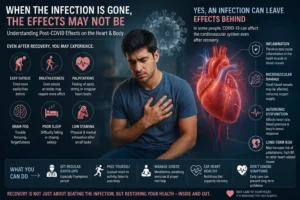
 The infection is over. The fever is gone. The cough has disappeared. Life seems to have returned to normal.
But for some people, something still feels different.
They may get tired more easily than before. Things that once felt simple—walking, exercising, working for long hours, even staying mentally active—may suddenly require more effort. Some people notice palpitations, breathlessness, poor sleep, brain fog or simply a feeling that their body is not working the way it used to.
At first, it is easy to ignore these changes.
“I am probably just tired.”
“Maybe I need to exercise more.”
“Maybe it is stress.”
But when these changes continue, another question naturally comes up:
Can an infection really leave effects behind after it is gone?
Increasing evidence suggests that, in some people, COVID-19 can have effects that extend beyond the initial infection. And one of the areas receiving considerable attention is the cardiovascular system—the heart and the blood vessels that keep the entire body supplied with oxygen.
The Part We May Have Underestimated
When we first heard about COVID-19, we mainly thought about the lungs.
But the human body does not work as a collection of separate organs. The lungs, heart, blood vessels, immune system and nervous system constantly interact.
That is why a severe infection can have effects far beyond the place where it first appears.
Research has reported increased risks of several cardiovascular problems after COVID-19, including heart failure, abnormal heart rhythms, ischemic heart disease, myocarditis and blood-clot-related complications. These risks are not the same for everyone, and having had COVID does not mean that a person will develop heart disease.
But the evidence is strong enough to make one thing clear:
COVID-19 deserves to be looked at as more than just a respiratory infection.
Where Does Inflammation Come Into the Picture?
One of the most important pieces of this story is inflammation.
Inflammation is not inherently bad. It is one of the body’s defence mechanisms. When an infection enters the body, the immune system responds, tries to eliminate the threat and begins the healing process.
The problem is that a powerful or poorly regulated inflammatory response can affect healthy tissues as well.
During COVID-19, inflammation can become widespread, particularly in severe infections. Researchers have also investigated persistent immune-system changes and inflammation in some people experiencing Long COVID.
This does not mean that everyone who feels tired after COVID has inflammation damaging their organs.
But it gives us an important biological possibility worth understanding.
Your Blood Vessels Are Part of the Story
We often talk about the heart as though it works independently.
It doesn’t.
Every heartbeat depends on blood vessels delivering oxygen throughout the body. The inside of these vessels is covered by a delicate layer called the endothelium.
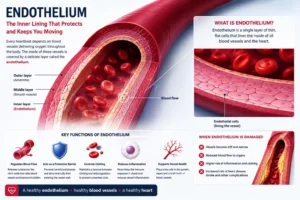
You can think of it as the protective lining of your blood vessels.
When this lining is healthy, blood vessels can regulate blood flow properly. When it becomes dysfunctional, the balance can change.
Inflammation, oxidative stress, abnormal clotting and endothelial dysfunction have all been investigated as possible pathways linking COVID-19 with cardiovascular complications.
This is important because cardiovascular disease is not simply about “a pipe becoming blocked.”
It is a biological process involving blood vessels, cholesterol, immune responses and inflammation.
Inflammation and Artery Disease
This is where an interesting connection appears.
Atherosclerosis—the process responsible for most coronary artery disease—develops gradually. Cholesterol-containing material can accumulate within artery walls, but inflammation also plays an important role in the development and instability of atherosclerotic plaques.
That is why inflammation is often described as part of the story behind artery disease.
We already know that several things can promote inflammation and vascular damage.
Smoking is one obvious example.
The chemicals in cigarette smoke can damage the blood-vessel lining, promote inflammation, affect blood clotting and accelerate atherosclerosis.
COVID-19 is obviously not the same as smoking.
But the comparison helps us understand a broader idea: different triggers can influence some of the same biological systems—particularly inflammation and blood-vessel function.
So, Can COVID Create a Blockage?
This is where we need to be careful.
It would be wrong to say that COVID simply “creates artery blockages.”
Atherosclerosis usually develops over a long period, influenced by factors such as genetics, cholesterol, blood pressure, diabetes, smoking, obesity and lifestyle.
However, an acute infection can place enormous stress on the cardiovascular system. Inflammation, changes in blood clotting, increased demand on the heart and endothelial dysfunction may contribute to cardiovascular complications, particularly in people who already have underlying risk factors.
In other words, COVID should not be blamed for every blockage.
But neither should its potential cardiovascular effects be dismissed.
Why Do Some People Feel So Different Afterwards?
This is perhaps the most relatable part of the story.
A person may say:
“I don’t feel sick. I just don’t feel like myself.”
That difference matters.
Fatigue after an infection can have many explanations. It can come from poor sleep, reduced physical activity, deconditioning, stress, autonomic nervous-system changes or ongoing post-viral symptoms.
Long COVID can involve fatigue, brain fog, palpitations, shortness of breath and reduced tolerance for physical activity.
And this is important: feeling exhausted does not automatically mean that the heart has become weak.
Sometimes the only way to know what is happening is to investigate it.
The Vaccine Question
For many people, the next question is obvious:
“Could the vaccine have caused all this?”
It is understandable why people ask.
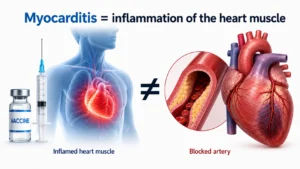
COVID vaccines have been associated with rare cases of myocarditis and pericarditis, particularly in certain younger male groups after mRNA vaccination. These conditions are real and should not be dismissed.
But myocarditis is not the same thing as a typical heart attack caused by a cholesterol-related coronary blockage.
At the population level, research has not established COVID vaccination as a general cause of increased heart attacks. At the same time, COVID infection itself has been associated with increased cardiovascular risk.
So the answer is not to choose a side based on fear.
The better approach is to separate what is biologically possible, what has actually been observed, and what has been proven by research.
That distinction matters.
Maybe the Real Problem Is Not “Weak Immunity”
There is another phrase we often hear:
“COVID weakened my immunity.”
There may be some truth behind the feeling, but the scientific reality is more complicated.
Researchers have found immune-system changes in some people with Long COVID. However, that does not mean that everyone who had COVID has a permanently weakened immune system.
The immune system is extremely complex.
Rather than thinking of immunity as a battery that becomes empty, it may be more accurate to think about the possibility of immune dysregulation or an immune response that takes time to return to normal in some people.
That is an area scientists are still studying.
And this is exactly why we should avoid simple explanations for complicated symptoms.
What Can We Actually Do?
The good news is that we are not completely powerless.
We cannot control whether our body experienced inflammation during an infection.
But we can control many of the factors that influence cardiovascular and overall health afterwards.
The basics matter enormously:
Sleep well. Eat a balanced diet. Move regularly. Avoid smoking. Maintain a healthy weight. Manage blood pressure, cholesterol and blood sugar. Stay hydrated. And find ways to reduce chronic stress.
There is no magical food that will suddenly “boost” the immune system.
Your body does not need a miracle ingredient.
It needs the right conditions to function well.
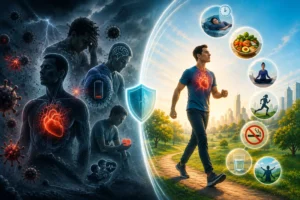
Recovery Should Be Gradual
If someone is still experiencing significant symptoms after COVID, simply forcing themselves through intense workouts may not always be the right answer.
Some people with Long COVID experience post-exertional worsening, where physical or mental activity can make symptoms considerably worse afterwards.
That is why recovery should be individual.
Start where your body allows you to start.
Build activity gradually when tolerated.
And if symptoms such as persistent breathlessness, chest discomfort, fainting, significant palpitations or unexplained exercise intolerance continue, medical evaluation is more useful than guessing.
Depending on the situation, a doctor may consider tests such as an ECG, echocardiogram, blood tests or other investigations.
The Bigger Lesson
Perhaps the most important lesson from COVID-19 is that the body is interconnected.
The immune system does not operate separately from the cardiovascular system.
Inflammation does not affect only one organ.
Blood vessels are not passive tubes.
And recovery is not always as simple as waiting for a fever to disappear.
For many people, COVID will remain an infection they recover from completely.
For others, the recovery process may be slower, and symptoms may deserve more attention.
That does not mean that every unusual sensation is permanent damage.
It means we should listen to the body without immediately jumping to conclusions.
Don’t panic. Don’t ignore. Investigate.
And perhaps most importantly, don’t look for one villain to explain everything.
The vaccine, the virus, stress, poor sleep, inactivity, smoking, cholesterol, blood pressure and many other factors can have very different roles in different people.
The science is still evolving.
But one thing is already clear: taking care of the heart after COVID is not about fear. It is about understanding how the body works and giving it the best possible conditions to recover.
COVID may be gone.
But your health journey doesn’t have to stop there.
Sometimes, recovery begins when we stop asking “What damaged me?” and start asking:
“What can I do now to help my body work better?”