
Lipoprotein(a) (Lp(a)): The Hidden Genetic Cholesterol That Can Increase Heart Attack Risk 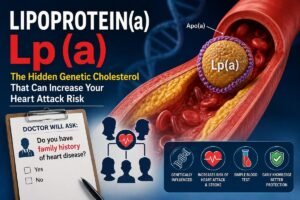
What if your cholesterol report looks normal—but your heart attack risk is still high?
Most people believe that if their LDL (“bad cholesterol”) is within the normal range, their heart is safe.
Unfortunately, that’s not always true.
Every year, many healthy-looking people—some in their 30s or 40s—experience heart attacks despite having no obvious symptoms and seemingly normal cholesterol levels. One possible reason is Lipoprotein(a), commonly written as Lp(a).
Unlike LDL cholesterol, Lp(a) is largely determined by your genes, not your lifestyle. That means even someone who exercises regularly, eats a balanced diet, and maintains a healthy weight may still have a high Lp(a) level.
Because Lp(a) is not included in most routine cholesterol tests, many people don’t know they have elevated levels until they develop heart disease or discover a strong family history of early heart attacks.
If you’ve never heard of Lp(a), you’re not alone—but understanding it could be one of the most important steps you take for your heart health.
What Is Lipoprotein(a)?
Think of LDL cholesterol as a delivery truck carrying cholesterol through your bloodstream.
Now imagine another delivery truck that has an extra sticky rope attached to it.
That sticky rope makes the truck more likely to cling to the walls of your arteries.
That is a simple way to understand Lp(a).
Lp(a) is a cholesterol-carrying particle that looks similar to LDL but has an additional protein called apolipoprotein(a) attached to it. This extra protein changes the way the particle behaves inside the body.
Compared with ordinary LDL, Lp(a) is more likely to:
-
- Stick to artery walls
-
- Contribute to plaque formation
-
- Promote inflammation
-
- Increase the tendency for blood clots
Over time, these effects may narrow the arteries supplying the heart and brain, increasing the risk of:
-
- Heart attack
-
- Stroke
-
- Peripheral artery disease
-
- Aortic valve disease
Why Is Lp(a) Called “Genetic Cholesterol”?
One of the biggest differences between LDL cholesterol and Lp(a) is where they come from.
Your LDL cholesterol is influenced by several factors:
-
- Diet
-
- Exercise
-
- Body weight
-
- Smoking
-
- Diabetes
-
- Certain medications
Lp(a) is different.
Around 80–90% of your Lp(a) level is determined by the genes you inherit from your parents. Your liver produces Lp(a), and the amount it makes is largely controlled by your DNA.
This means:
-
- A healthy lifestyle may not significantly lower a high Lp(a) level.
-
- Two people with the same diet and exercise habits can have very different Lp(a) levels.
-
- High Lp(a) often runs in families.
If one of your parents has high Lp(a), there is a greater chance that you may have inherited it as well.
Why Is High Lp(a) Dangerous?
Heart disease usually develops gradually over many years.
When cholesterol particles enter the artery wall, they can trigger inflammation. Over time, cholesterol, calcium, and inflammatory cells build up to form plaque.
Lp(a) can accelerate this process in several ways:
1. It contributes to plaque build-up.
Lp(a) can become trapped inside artery walls, adding to plaque formation.
2. It promotes inflammation.
Inflammation makes plaques more unstable and increases the likelihood that they may rupture.
3. It may interfere with the body’s normal clot-dissolving processes.
This can increase the chance of a blood clot forming after a plaque ruptures, potentially leading to a heart attack or stroke.
These combined effects help explain why elevated Lp(a) is associated with a higher lifetime risk of cardiovascular disease.
Can Healthy People Have High Lp(a)?
Yes.
This is one of the most important facts to understand.
A person can:
-
- Exercise regularly
-
- Maintain a healthy weight
-
- Eat nutritious food
-
- Have normal LDL cholesterol
-
- Never smoke
…and still have a high Lp(a) level.
That’s because lifestyle does not fully determine Lp(a).
For example:
Rahul is 34 years old. He runs five days a week, has normal blood pressure, and his cholesterol report looks acceptable.
However, his father had a heart attack at age 45.
His doctor orders an Lp(a) test, which reveals a significantly elevated level.
Although Rahul cannot change the genes he inherited, he now knows he has an increased cardiovascular risk. Together with his healthcare team, he can focus on reducing other risk factors and making informed treatment decisions.
Who Should Consider an Lp(a) Test?
Many medical societies recommend measuring Lp(a) at least once in adulthood, particularly for people with increased cardiovascular risk.
Testing may be especially useful if you:
-
- Have a parent or sibling with high Lp(a)
-
- Experienced a heart attack or stroke at a relatively young age
-
- Have high LDL cholesterol that remains difficult to control
-
- Have recurrent cardiovascular disease despite treatment
-
- Have a strong family history of unexplained heart disease
Your healthcare provider can advise whether Lp(a) testing is appropriate for your situation.
How Is Lp(a) Measured?
The Lp(a) test is a simple blood test.
Unlike some cholesterol tests, fasting is not always required, although your healthcare provider may give specific instructions depending on whether other blood tests are being performed at the same time.
Results are commonly reported in:
-
- mg/dL (milligrams per deciliter)
-
- nmol/L (nanomoles per liter)
Because different laboratories use different measurement methods, results should always be interpreted using the reference ranges provided by your laboratory and discussed with your doctor.
Can High Lp(a) Be Treated?
At present, lifestyle changes usually have only a modest effect on Lp(a) levels themselves.
However, this does not mean lifestyle changes are unimportant.
Healthy habits remain one of the best ways to lower your overall cardiovascular risk, especially if you have elevated Lp(a).
Your doctor may recommend:
-
- Controlling LDL cholesterol aggressively
-
- Maintaining a healthy body weight
-
- Exercising regularly
-
- Eating a heart-healthy diet
-
- Managing blood pressure
-
- Controlling diabetes
-
- Avoiding smoking
-
- Taking medications when appropriate
Researchers are also developing newer therapies that specifically target Lp(a). Several treatments are being studied, and some may become more widely available as evidence continues to grow.
Practical Steps to Protect Your Heart

If your Lp(a) level is high, don’t panic.
Remember:
Your genes are not your destiny.
While you cannot choose the genes you inherit, you can influence many other factors that affect heart health.
Focus on:
✔ Knowing your numbers
✔ Keeping LDL cholesterol under control
✔ Staying physically active
✔ Eating a balanced diet
✔ Managing blood pressure and diabetes
✔ Avoiding tobacco
✔ Following your doctor’s advice
Early awareness gives you the opportunity to act before serious problems develop.
In short
Lipoprotein(a), or Lp(a), is often called the hidden genetic cholesterol because it is not routinely measured and is largely inherited rather than caused by lifestyle.
A high Lp(a) level can increase the risk of heart attack, stroke, and other cardiovascular diseases—even in people who appear healthy or have normal LDL cholesterol.
The good news is that once you know your Lp(a) level, you and your healthcare provider can make informed decisions about managing your overall cardiovascular risk.
Heart disease prevention isn’t only about treating problems after they appear—it’s about identifying hidden risks early and taking steps to protect your future.
If you have a family history of premature heart disease or unexplained cardiovascular events, speak with your healthcare provider about whether an Lp(a) test is right for you.
Related Articles on HeartBacks