What if your cholesterol report looks “normal,” but your heart disease risk is still higher than you think?

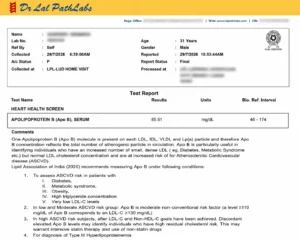
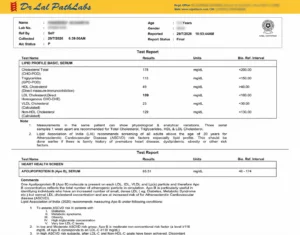
I just bought a heart health tset package on 29th July and got my blood tested. Recently, while reviewing my blood test report, I came across a term I had never really paid attention to before—ApoB. Like many people, I had always focused on LDL, HDL, and triglycerides. But after learning more about ApoB, I realized I had been looking at only part of the picture. . Because I keep a track on cholesterol in every 3 months. *
We All Know About LDL… But What About ApoB?
Whenever I thought about cholesterol, three things came to mind:
- LDL (Low-Density Lipoprotein) – often called “bad cholesterol”
- HDL (High-Density Lipoprotein) – known as “good cholesterol”
- Triglycerides – another important type of blood fat
Every time I received a lipid profile report, these were the numbers I checked. If my LDL was high, I worried. If my HDL was good, I felt relieved.
But during my recent blood test, I noticed something new.
ApoB.
Honestly, I didn’t know what it meant.
That curiosity led me to spend hours reading research, medical guidelines, and expert opinions. What I discovered changed the way I look at cholesterol reports.
If you’ve never heard of ApoB, you’re not alone.
What Is ApoB?
ApoB (Apolipoprotein B) is a protein found on the surface of cholesterol-carrying particles that can contribute to plaque buildup inside arteries.
Every harmful cholesterol particle carries one ApoB molecule.
This means your ApoB level gives doctors an estimate of how many potentially artery-clogging particles are circulating in your bloodstream, not just how much cholesterol they contain.
That may sound like a small difference, but it can be extremely important.
LDL vs ApoB: Understanding the Difference
One of the easiest ways to understand this is through a simple example.
Imagine cholesterol is being transported by trucks on a highway.
- LDL cholesterol tells you how much cargo all those trucks are carrying.
- ApoB tells you how many trucks are actually on the road.
Both pieces of information matter.
Two people may have exactly the same LDL cholesterol level, yet one person may have far more cholesterol-carrying particles. More particles mean more opportunities for those particles to enter artery walls and contribute to plaque formation over time.
That is why ApoB has become an increasingly important marker in cardiovascular medicine.
Why LDL Doesn’t Always Tell the Whole Story
For decades, LDL cholesterol has been one of the primary measurements doctors use to estimate heart disease risk.
And it remains an important test.
However, LDL measures the amount of cholesterol carried inside lipoproteins—not the number of particles carrying that cholesterol.
Imagine these two people:
Person A
- LDL Cholesterol: 130 mg/dL
- ApoB: Lower
Person B
- LDL Cholesterol: 130 mg/dL
- ApoB: Higher
Both have the same LDL cholesterol level.
But Person B has more cholesterol-carrying particles circulating in the blood.
More particles can increase the chance of cholesterol entering artery walls, which may increase cardiovascular risk.
This is why ApoB can provide additional information beyond LDL cholesterol alone.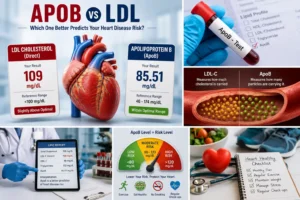
My Own Blood Test
When I reviewed my latest blood report, my LDL cholesterol immediately caught my attention.
Then I noticed another result—ApoB.
Until that day, I honestly had no idea what ApoB measured.
That single test encouraged me to learn more about cholesterol rather than simply looking at one number and assuming I understood my heart health.
(Insert your blood test report image here.)
What Is a Healthy ApoB Level?
While your healthcare provider should interpret your results based on your overall health, many experts generally consider the following targets:
| ApoB Level | General Interpretation |
|---|---|
| Below 90 mg/dL | Optimal for many adults |
| Below 80 mg/dL | Often recommended for people at high cardiovascular risk |
| Below 65–70 mg/dL | May be recommended for very high-risk individuals under specialist care |
Remember, these targets can vary depending on your medical history and current treatment plan.
Who Should Consider an ApoB Test?
Your doctor may consider ordering an ApoB test if you have:
- A family history of heart disease
- High LDL cholesterol
- High triglycerides
- Diabetes
- Obesity
- Metabolic syndrome
- Previous heart attack or stroke
- Borderline cholesterol results where additional risk assessment is helpful
Not everyone needs this test, but for some people it provides valuable additional information.
Can You Lower ApoB?
The encouraging news is that many of the habits that improve overall heart health can also help reduce ApoB.
Lifestyle changes
- Eat more vegetables, fruits, legumes, and whole grains.
- Increase dietary fiber.
- Limit saturated and trans fats.
- Maintain a healthy weight.
- Exercise regularly.
- Quit smoking.
- Get adequate sleep.
- Manage stress.
Medications
When lifestyle changes are not enough, doctors may recommend medications such as:
- Statins
- Ezetimibe
- PCSK9 inhibitors
These medications should only be taken under medical supervision.
Is ApoB Better Than LDL?
This isn’t really a competition.
LDL cholesterol remains an essential part of cardiovascular risk assessment.
However, ApoB offers another layer of information by estimating the number of cholesterol-carrying particles that may contribute to plaque formation.
Instead of replacing LDL, ApoB helps complete the picture.
Frequently Asked Questions
Can my LDL be normal while ApoB is high?
Yes. In some people, LDL cholesterol may appear acceptable while ApoB indicates a higher number of atherogenic particles.
Is ApoB included in a standard lipid profile?
Usually not. It often requires a separate blood test.
Should everyone get an ApoB test?
Not necessarily. Your healthcare provider can determine whether it is appropriate based on your personal risk factors.
Can diet and exercise reduce ApoB?
Yes. Healthy lifestyle habits can improve cholesterol metabolism and may help lower ApoB levels.
Final Thoughts
Before this blood test, I believed cholesterol was mainly about LDL, HDL, and triglycerides.
Learning about ApoB reminded me that heart health is often more complex than a single number on a report.
This article isn’t meant to replace medical advice. It’s simply my journey of understanding a test I had never paid attention to before—and sharing what I learned in the hope that it helps someone else ask better questions during their next health check-up.
Sometimes, improving your heart health doesn’t begin with a new medicine.
Sometimes, it begins with understanding your own blood report.
Key Takeaways
- ApoB stands for Apolipoprotein B.
- ApoB estimates the number of potentially artery-clogging lipoprotein particles.
- LDL cholesterol measures how much cholesterol those particles carry.
- ApoB and LDL provide different but complementary information.
- If you have multiple cardiovascular risk factors, ask your healthcare provider whether an ApoB test could be useful for you.
lastly, here are the SS of my test report, Apob is fine but LDL needs to be controlled.